
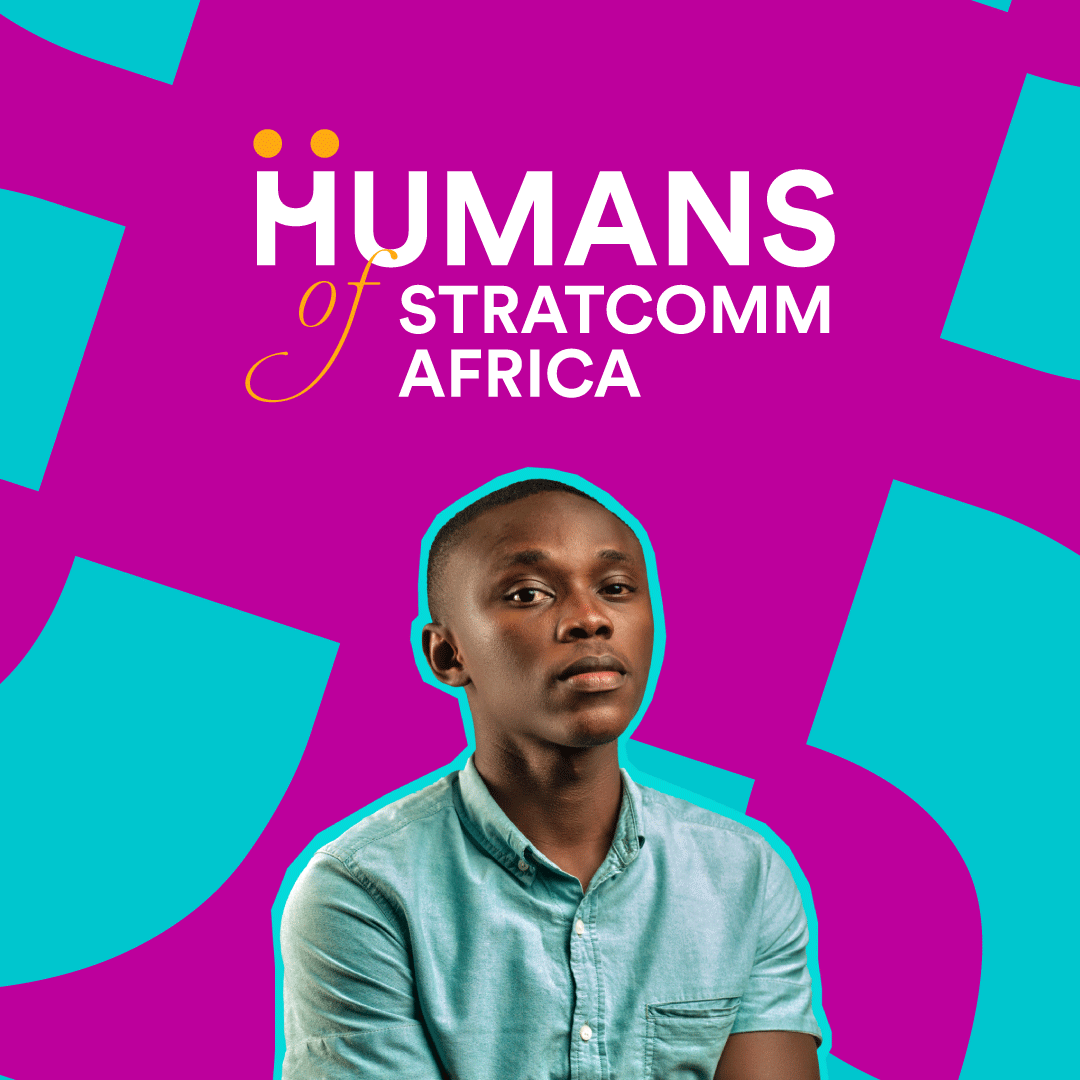
Humans of Stratcomm Africa: Meet Kelvin, Senior Digital Communications Officer
How curiosity led Kelvin Agyapong from managing a store to managing a brand voice through storytelling.
Tell us a little bit about yourself.
- Where did you grow up?
I was born and raised in Accra, Dansoman, to be specific, where I spent most of my formative years. I also had a brief but impactful childhood experience living in the Zongo community around Abossey Okai.
- What did you study in university and why?
I studied Publishing Studies, an Art programme, at Kwame Nkrumah University of Science and Technology. Honestly, I was all over the place when it came to choosing a course — I toyed with the idea of studying Law, considered Business Administration, but somehow landed in Publishing Studies. At the time, it felt ‘unfortunate’ — not going to lie — but in hindsight, it is what laid the foundation for my current path.
- What do you do at Stratcomm Africa?
I serve as a Senior Digital Communications Officer. My role spans across digital communication strategy development, implementation, content creation, account and community management, and analytics. I have a hand in pretty much every stage of the communication process, from planning to monitoring and evaluation.
Your career journey has been quite dynamic. How did you go from Publishing Studies to digital communications?
Publishing Studies to Digital Communications is more of a progression than a switch. Contrary to popular belief (or sarcasm), Publishing Studies entails more than books and printing. The programme is layered with communication, marketing, editing, graphic design, and even basic coding. So in a way, it quietly groomed me for digital comms before I even knew I would end up here.
You’ve worked as a graphic designer, shop manager, content creator, and now a senior digital communications officer. What motivated those transitions?
Firstly, interning as a graphic designer and working as a shop manager (roles I still juggle today) was not necessarily a matter of choice – it had to do with who had the most control and the circumstances during those periods. But looking back, those experiences taught me more than I could have imagined.
My actual journey started with content creation. Back in school, I would casually critique lyrics, movie scripts and marketing pieces; not professionally, just for fun. I had a knack for writing, so I joined a writers’ group and later collaborated on a student blog. When a digital comms opportunity finally came along, I realized I had something of value, a skill I could cash in on Since then, the demands of the industry have pushed me to expand my skill set exponentially.
What does a typical day look like for you at Stratcomm Africa?
My day usually kicks off with a to-do list; every task I plan to tackle in the day I picked up that habit from a few colleagues, and it’s been super helpful. I start with community management – checking messages and comments for lead-focused accounts – then move on to emails. After that, the rest of the day unfolds based on shifting priorities, timelines and team needs.
What’s one campaign or project you’ve worked on that you’re especially proud of? Why?
One campaign that stands out for me is the work we did for Roboserve Canada. It was one of those projects that felt like a crash course in understanding a niche brand, a foreign audience and a fast-evolving product, all at once. Roboserve is a robotics company that provides smart serving robots to restaurants and healthcare facilities, and our job was to help them strengthen their digital presence with a modern website.
What made it special? It was more than pushing a cool tech product. We had to educate the audience, build trust, and show the real-world usefulness of these machines; especially in a post-COVID world where contactless service became a selling point. We had to find creative ways to humanize a very non-human product, and that challenge was exciting.
It’s still early days, but being part of something from the ground up, especially for such a unique product, has been really fulfilling.
You’ve grown through multiple roles within Stratcomm Africa – from intern to senior digital comms officer. What has that growth taught you about the digital space in Ghana?
One of the first things I learnt, sometimes the hard way, is that the Ghanaian digital space is not for the faint-hearted. To thrive here, you can’t afford to be good at just one thing. You have to be a jack of all trades and, ideally, a master of at least two or three.
Yes, you can coast by doing the bare minimum but that’ll only keep you at surface level.
Also, the collaborative nature of agency work means you’re constantly brushing up against other disciplines. One day, you’re wearing the strategist cap, the next, you’re dabbling in copywriting, then before you know it, you’re deep in analytics. That constant back-and-forth pushes you to sharpen your skills across multiple fronts.
So, my growth at Stratcomm has taught me that to stay relevant, you don’t just adapt; you anticipate. You don’t just participate; you bring something different to the table, every single time.
What do you love most about working in digital communications?
What I love most is how blurred the lines have become between work and learning, leisure and inspiration. Everything is digital now. You could be casually scrolling through your social media feed, just looking for a meme to laugh at, and suddenly, you’re learning something new or picking up an idea for your next campaign. It’s like the universe hands you free strategy sessions disguised as fun.
That’s the beauty of it! And if you’re wired a certain way, this is the dream learning style. You get to think, test, fail, tweak, and still stay ahead. It keeps you sharp without always feeling like “work”.
What has been the most challenging part of your career so far and how did you overcome it?
One of the biggest challenges has been figuring out what to learn, how to learn it, and when to apply it, especially in a fast-paced industry. It’s one thing to hear about all these innovations, but another to get actual hands-on experience, mostly when your day-to-day tasks don’t immediately demand them.
Take AI in digital communication, for example. You know it’s important. You know it’s the future. But if you’re not currently on a project that requires it, you are stuck in this weird limbo where you want to learn, but there’s no direct sandbox to play in.
What helped me was accepting that it’s okay to learn on the job. Not everything needs to start with a full course or a big project. Sometimes, you create your own small experiments, like testing a tool on a personal project or using a new approach in something low risk. Other times, you just must be disruptive; introduce an idea into a campaign even if no one asked for it, just to see what happens.
What advice would you give to someone who wants to break into the digital comms industry, especially in Ghana?
First, be good at something. In a space as competitive and fast-paced as digital communications in Ghana, you need a core skill you can hang your hat on. It could be social media management, copywriting, graphic design, photography or even videography—just have that one thing that, when the call comes, people can confidently say, “Let’s give it to this person.”
But don’t stop there. Have some working knowledge of the other things that orbit your core skill. If you’re a designer, understand the basics of content strategy. If you’re a social media manager, know how analytics work. These adjacent skills make you more valuable and easier to collaborate with.
And for everything else? You learn as you go. The industry is constantly shifting, and no one starts out knowing it all. The real edge comes from staying curious, staying open, and being willing to put in the reps, even when you don’t have it all figured out.
What do you do to stay inspired or creative? Any routines, side projects, or creative outlets?
Honestly, I wish I could say I have a go-to ritual or creative routine, but it’s not that straightforward. I’ve realised that whenever I go actively hunting for ideas, I usually return empty-handed or more overwhelmed than before.
But then, out of nowhere, days or weeks later, an idea will pop into my head. And when I trace it back, it usually connects vaguely to something I saw, heard or experienced earlier.
So for me, inspiration works more like planting seeds. Things take time to germinate beneath the surface. By the time the idea sprouts, I’ve often forgotten where it came from.
That said, lately, I’ve been more intentional about feeding my mind. I’ve subscribed to a bunch of newsletters, marketing platforms and social media accounts that are dedicated to communications trends, strategies, and storytelling. I’m also slowly making headway with AI tools; it’s still early days, but the possibilities are exciting.
So yeah, while I still believe in the magic of delayed inspiration, I’m also building better habits to make sure the soil is fertile when the seed finally decides to grow.
Outside of work, who is Kelvin?
I am the guy you’re unlikely to bump into in town, because most of the time, I’m indoors. My idea of a good time is to have earphones in, a podcast or music on, or just zoning out with a good movie.
I do hang out with friends every now and then, but those moments are rare and rationed. Being out feels like work , so I keep it minimal.
I don’t have a routine, though. I wish I did, but I get spontaneous sometimes — random decisions, last-minute plans and the occasional “why did I even do that?” moments. Some things I do, I wouldn’t even like to mention (laughs).
Nothing too exciting.